

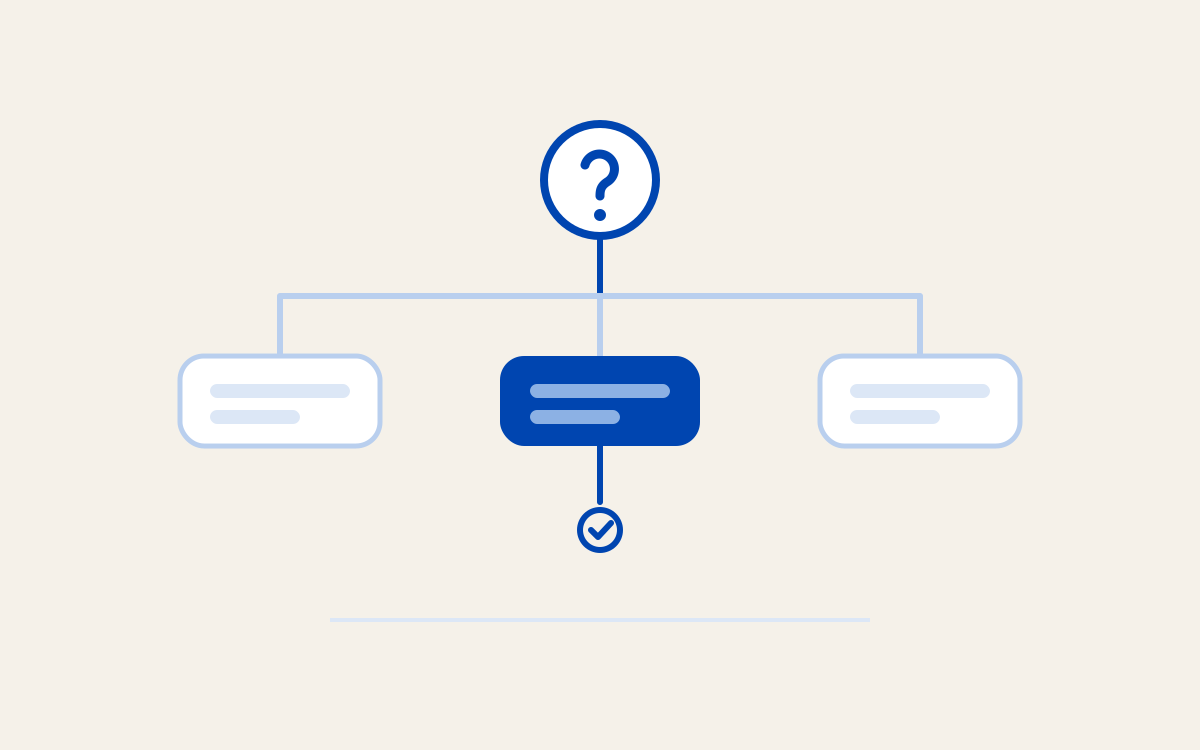
Teams can spend weeks comparing inference frameworks and still choose the wrong architecture. The benchmark table is rarely the problem. The harder questions concern data boundaries, model variety, traffic shape and who will operate the system after launch.
An LLM inference stack is the software and infrastructure that loads models, schedules requests, manages GPUs, exposes APIs and reports what happened. The right stack for a single experiment may be a poor fit for a regulated, multi-model service.
Use the following questions to narrow the decision before running a proof of concept.
1. Can the workload use a third-party API?
Start with the data boundary. If prompts and outputs can be processed by an external provider, a managed model API is often the fastest route to production. It removes model hosting and GPU operations from the team's workload.
Self-hosted or private-cloud inference becomes relevant when policy, contracts, residency requirements or latency require the model to run inside infrastructure you control. It may also be appropriate when steady traffic makes fixed-capacity economics attractive.
Do not reduce this decision to "private is secure" and "API is not." Security depends on architecture and operation. Define where data may travel, who can access it, how logs are retained and which controls the provider or internal platform supplies.
2. How many model types will the application serve?
A focused application may need one text model and one embedding service. A wider platform can quickly accumulate LLMs, embedding models, rerankers, speech models and vision models.
One model type favors a specialized serving engine with a thin API layer. Several model types favor a unified control plane, especially when teams need shared authentication, quotas, observability and lifecycle management.
Count expected models twelve months from now, not only the models in the first release. The second and third teams often create more integration work than the first model did — the pattern we described in from model selection to fleet management.
3. What does the latency objective actually measure?
"Low latency" is not a requirement. Define time to first token, time per output token and end-to-end response time at P50, P95 and P99.
Interactive chat may care most about time to first token. Batch extraction cares about completed documents per hour and cost. An agent may be sensitive to the accumulated latency of several model and tool calls.
Serving features such as continuous batching, KV-cache reuse, quantization and speculative decoding can help, but each has workload-dependent trade-offs. Benchmark them on representative prompts and concurrency. A single-request test does not predict production behavior.
4. What does traffic look like?
Record average load, peak load, burst duration, request size and idle periods. Stable, high utilization favors reserved or owned capacity. Spiky workloads may favor managed APIs, autoscaling or a hybrid design.
Traffic shape also determines whether several models can share a GPU pool. Co-location can improve utilization, but memory pressure and noisy-neighbor effects can damage tail latency. Test the exact model combination rather than applying a fixed utilization target.
5. Will the system cross one GPU or one node?
A single-node server is simpler and may be all you need. Larger models or higher concurrency introduce distributed scheduling, tensor or pipeline parallelism, load balancing and fault recovery.
At that point, framework speed is only one criterion. Evaluate failure handling, model rollout, replica placement, capacity management and the operational cost of upgrading drivers and runtimes.
Xinference supports distributed inference with supported engines including vLLM and SGLang. Confirm the current model and engine compatibility before choosing a deployment pattern.
6. How much application coupling can you accept?
A common API limits migration work when models or engines change. OpenAI-compatible endpoints are useful because many application libraries already support them, but compatibility is not always identical. Test streaming, tool calls, structured output, embeddings and error behavior.
Also ask whether the application knows which GPU or engine serves a request. That detail usually belongs in the platform. Tight coupling makes every model or hardware change an application change.
Three practical stack patterns
Managed API
Choose this when the workload can leave your boundary, traffic is uncertain and the team does not want to operate models. It is also useful for frontier capabilities that do not have a suitable self-hosted alternative.
Specialized model server
Choose this for a narrow, stable workload with one model family and a team comfortable operating the runtime. It keeps the system small and lets engineers tune deeply for that model.
Unified inference platform
Choose a unified inference platform when several teams share models and GPUs, deployments span cloud and on-prem environments, or governance must be consistent across the fleet. The platform should centralize API access, scheduling, model lifecycle, routing and observability without hiding the underlying runtime.
Hybrid architectures are common. A unified API can send steady, sensitive workloads to private capacity and use an external API for experiments, rare edge cases or temporary bursts.
What to test in the proof of concept
Use two or three representative models and production-like concurrency. Measure success rate, P95 latency, throughput, GPU memory, utilization, startup time and cost per successful request. Test a model update and a worker failure. Review the logs with both the engineering and security teams. If you are starting from zero, deploying a first model on Xinference takes about 10 minutes.
The simplest stack that passes those tests is usually the right choice. A fast benchmark is useful. A stack that stays understandable after six models, three teams and a driver upgrade is more useful.