

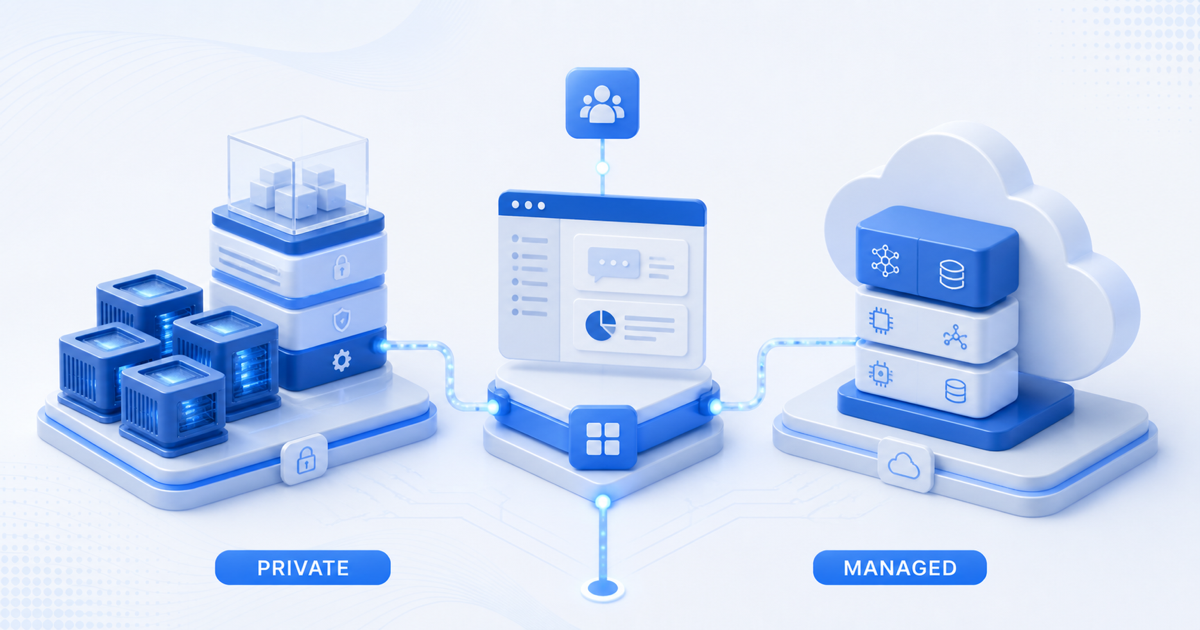
Amazon Bedrock and Xinference both expose models through APIs, but the operating model is different. Bedrock is a managed AWS service. Xinference is software you run on infrastructure you control, from a laptop to a distributed cluster.
That difference affects operations, model choice, data boundaries, portability, and cost. It does not make either option universally better.
What Amazon Bedrock manages
Bedrock gives AWS customers managed access to foundation models, IAM-based access control, CloudWatch integration, scaling options, and other AWS services for building generative AI applications. Teams do not provision or patch GPU servers for standard on-demand model calls.
Bedrock also supports more customization than an earlier version of this draft stated. Depending on the model and region, teams can fine-tune supported foundation models or import compatible customized open-weight models. Custom Model Import has its own architecture, region, feature, and pricing constraints, so check the current AWS documentation for the exact model you plan to use.
Bedrock is a strong fit when the application already lives in AWS, traffic is variable, and the team prefers a managed service over operating an inference cluster.
What Xinference puts under your control
Xinference serves language, embedding, reranking, image, audio, and multimodal models through a unified API. It supports multiple inference backends and can run locally, in a private cloud, or on premises. Its documentation covers distributed deployment, authentication, audit logging, metrics, replicas, continuous batching, and several serving engines.
This model gives the operator control over model weights, network boundaries, storage, hardware, upgrade timing, and observability. That control also creates work. Your team owns capacity planning, patching, high availability, incident response, and the security of the deployment.
Data protection and residency
The earlier draft incorrectly said AWS could use Bedrock prompts and outputs to improve its base models. AWS states that Bedrock does not store or log prompts and completions for service improvement and does not use them to train AWS models. AWS also provides encryption and private networking options. Verify the current service terms, selected model provider, region, logging configuration, and any optional features before approving a regulated workload.
Self-hosting with Xinference can keep model traffic inside infrastructure you operate. It can simplify some residency requirements because you select the physical and network location. It does not make a deployment compliant by itself. Identity, encryption, retention, backups, audit access, incident response, and the surrounding application still matter.
Model choice and customization
Bedrock offers a managed catalog and supports selected customization and import paths. Availability varies by model, account, feature, and region.
Xinference is useful when you need a broad open-weight catalog, several serving backends, quantized variants, or models that are not available through a managed catalog. Compatibility still depends on model architecture, format, hardware, backend, and license.
Cost structure
Do not compare the two with a universal token threshold. Bedrock pricing varies by model, region, throughput mode, customization path, and optional services. Self-hosted cost depends on GPU acquisition or rental, utilization, power, storage, networking, support, and engineering time.
A useful comparison uses the same workload on both options:
- Measure input and output tokens, concurrency, context length, latency targets, and traffic variability.
- Price the relevant Bedrock model and throughput mode using the current AWS pricing page.
- Benchmark a representative model on the hardware you would actually operate with Xinference.
- Include idle capacity, failover headroom, observability, support, and on-call labor.
- Recalculate under low, expected, and peak demand.
Managed APIs often suit small or bursty workloads. Self-hosting can become attractive for sustained demand when the team can keep hardware useful, but it is not automatically cheaper.
Portability and operations
Bedrock integrates closely with AWS identity, networking, monitoring, and application services. That reduces integration work for AWS teams but increases dependence on AWS service interfaces and regional availability.
Xinference exposes OpenAI-compatible APIs and can run across environments you control. Portability is better at the serving layer, although moving a production deployment still requires work around storage, networking, secrets, GPUs, and operations.
Decision framework
Choose Bedrock when you value managed operations, already use AWS heavily, want access to its model catalog, or have variable demand that does not justify a dedicated serving estate.
Choose Xinference when you need private deployment, direct control over models and hardware, several inference backends, or a serving layer that can move across your own environments.
Run a pilot before deciding. Compare task quality, latency distributions, failure behavior, operational effort, and total cost using the same traffic sample.