

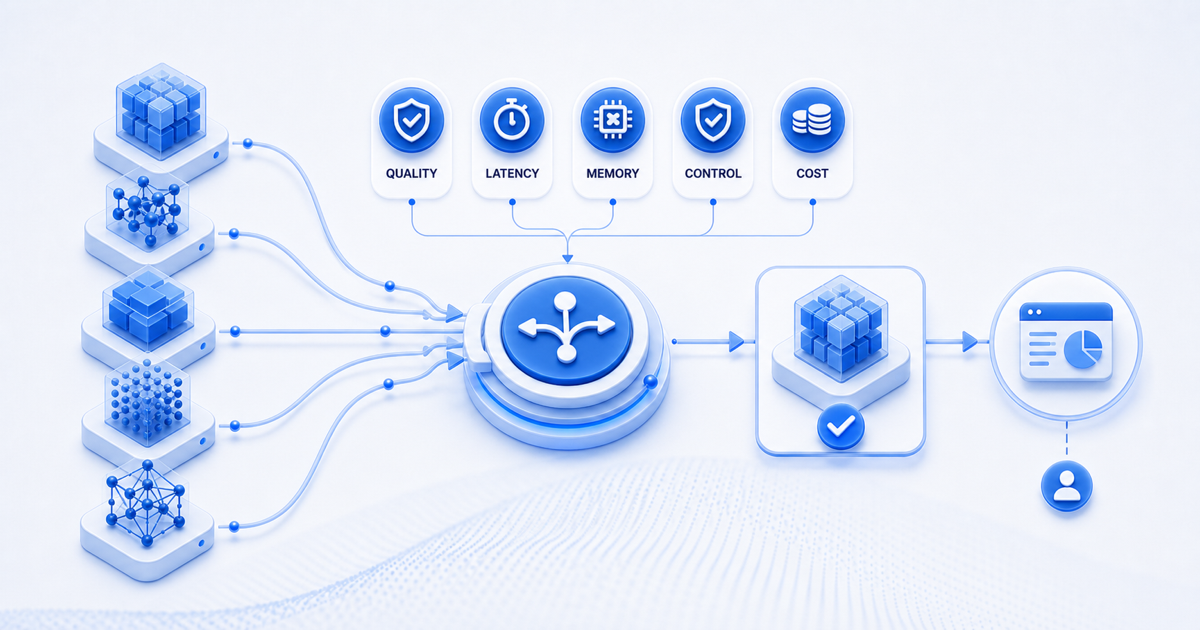
Model selection should begin with the workload, not a leaderboard or parameter count. The best production model is the smallest, simplest option that meets the required quality, latency, governance, and reliability thresholds on your own data.
Define the task and risk
Separate workloads such as extraction, classification, retrieval, summarization, code generation, image understanding, and long-form reasoning. One model may not be best for all of them.
Document the cost of a wrong answer. A low-risk drafting assistant and a regulated decision-support system need different evaluation and review gates.
Build a representative evaluation set
Use real, de-identified inputs that cover normal traffic, edge cases, long contexts, multiple languages, adversarial instructions, and tool failures. Keep a holdout set that is not used while tuning prompts.
Score task-specific outcomes. Exact match, structured-output validity, groundedness, retrieval quality, human preference, and policy compliance are often more useful than a single general benchmark.
Measure serving behavior
Quality is only one dimension. Record:
- Time to first token and inter-token latency.
- End-to-end latency at several concurrency levels.
- Throughput and queueing under sustained load.
- Memory use, startup time, and replica recovery.
- Input and output tokens per completed task.
- Failure, timeout, and retry rates.
Test the exact model format, quantization, backend, context length, and hardware you intend to operate. Published benchmark numbers rarely match a different stack.
Compare governance and licensing
Review the model license, permitted use, distribution terms, training-data restrictions where relevant, and the evidence your risk team requires. Decide where prompts, retrieved data, logs, and model weights may reside.
For managed APIs, review region availability, data terms, retention controls, access policy, and model lifecycle. For self-hosting, include patching, vulnerabilities, access control, backups, and incident response.
Estimate total cost per successful task
Per-token cost alone can mislead. Include retries, long contexts, tool calls, idle capacity, failover headroom, storage, networking, observability, support, and engineering labor.
Use:
cost per successful task = total operating cost / accepted completed tasks
This penalizes a cheap model that fails often or creates more review work.
Shortlist and pilot
Select a small set of candidates that pass the quality and governance gates. Run them on the same traffic sample and compare distributions, not only averages.
Use shadow traffic or a limited cohort before changing production behavior. Set rollback thresholds for quality, latency, error rate, and cost.
Where Xinference fits
Xinference provides a consistent serving API for a broad catalog of compatible language, embedding, reranking, image, audio, and multimodal models. It supports several backends and deployment patterns, which makes side-by-side testing easier.
Compatibility varies by model, format, backend, accelerator, and operating system. Check the current documentation, then benchmark the exact candidate rather than assuming every model can use every optimization.
The decision is complete only when one candidate meets the workload's acceptance criteria and the team can operate it reliably.