

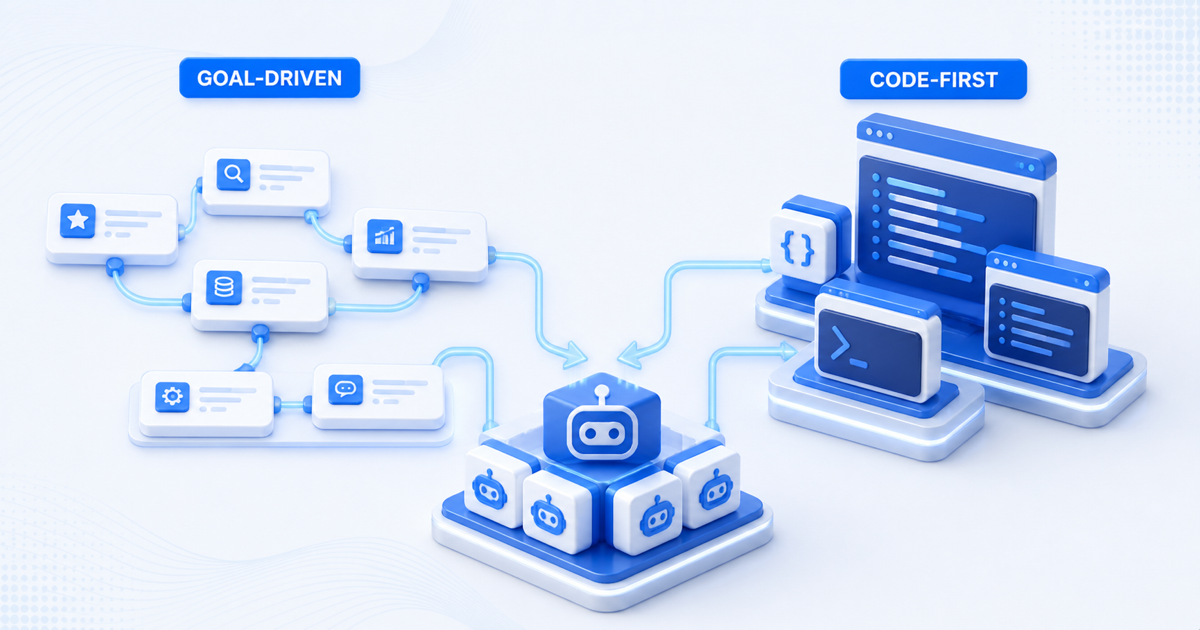
CrewAI and Xagent both coordinate agents and tools, but they start from different authoring experiences.
CrewAI is a Python framework with agents, crews, tasks, and flows. Xagent is a goal-driven agent platform for personal tasks, reusable team agents, and self-hosted enterprise deployments. The choice is less about "code versus no code" than about who will build, operate, and change the system.
CrewAI: a framework for software teams
CrewAI gives Python developers direct control over agent definitions, tools, state, routing, guardrails, callbacks, and deployment code. Its Flows support event-driven control and long-running stateful workflows, while Crews coordinate autonomous roles.
CrewAI documents observability, enterprise deployment, triggers, team management, and role-based access features, and the open-source framework integrates with normal Python testing and logging practices.
CrewAI fits teams that want agent behavior to live in a codebase with source control, tests, custom libraries, and established software delivery practices.
Xagent: start from the outcome
Xagent asks users to describe a task or reusable agent, attach files and knowledge, select tools and models, and inspect progress as the system plans and executes. It supports personal use, team-published agents, and self-hosted enterprise setups. Tools can include files, APIs, internal systems, knowledge bases, and MCP integrations.
Calling Xagent purely "no-code" is too narrow. Non-developers can work through the interface, while engineers still configure models, tools, permissions, deployment, and integrations. Complex production use cases need testing and operations even when the agent definition is written in plain language.
Authoring and change management
CrewAI makes code the primary artifact. That supports precise review, automated tests, reusable Python components, and custom control flow. Changes follow the team's normal development lifecycle.
Xagent makes the task definition, tools, knowledge, model settings, and published agent the primary artifacts. It is easier for operations or domain teams to inspect and iterate, while platform teams retain control over the runtime and connected systems.
Observability and debugging
Both approaches need more than a transcript. Capture task state, prompts, model calls, tool inputs and outputs, latency, token usage, errors, retries, human approvals, and final outcome quality.
CrewAI can use framework callbacks and observability integrations alongside application logs. Xagent exposes task progress, execution state, tool calls, and token usage in its platform. The right choice depends on whether your team prefers code-native telemetry or an integrated operator view.
Deployment and control
CrewAI applications can be packaged and deployed using the team's Python and cloud stack or CrewAI's enterprise services.
Xagent can run locally or be self-hosted for teams, and it can connect to API-based models or self-hosted models through Xinference. Production deployments still need TLS, identity, secrets, backups, network policy, monitoring, and a documented upgrade path.
Decision framework
Choose CrewAI when Python engineers own the system, custom control flow is central, and the organization wants agent logic reviewed and tested as code.
Choose Xagent when domain teams need a direct authoring experience, reusable agents and team publishing matter, or the organization wants a unified platform for tasks, tools, models, knowledge, and operations.
A hybrid is possible. Use each only where its operating model fits, and avoid splitting one workflow across platforms unless the boundary is clear and observable.